Since starting the Compact Challenge, I’ve tried to avoid purchasing new clothing. I was doing pretty well until I found myself browsing through the Forever 21 website about a week and a half ago. I ended up buying a sweater and a wallet. Granted this was less than what I usually buy, I still felt really guilty. I felt even worse because I know that I should not shop at stores like Forever 21 because of their history of unfair business practices. Byun’s article, “Forever in Trouble”, sheds light on the poor working conditions that these predominantly undocumented immigrants work under. Despite all the complaints and protests, Forever 21’s owners (Chang family) claimed that they are not responsible for these injustices because they are strictly a retailer (Byun 5). The workers reported being greatly underpaid, not having clean water, and working in dirty factories. PBS showed a documentary on the lives of some of these workers.
According to an article from CorpWatch, a settlement has been reached between Forever 21 and the garment workers. However, I still wonder how Forever 21 is able to keep their clothing at low prices while giving the garment workers better wages and working conditions.
Even though consumers are well aware of Forever 21’s history, why do we continue shopping there? It’s hard to keep up with what’s new in the fashion industry, but Forever 21 makes these trends accessible to broke college students like me. But we have to keep in mind that these trends come as quickly as they go. Before you know it, you’ll have to change your wardrobe again.
I’m definitely going to try to avoid shopping at Forever 21. Instead I will opt to buy used clothing from stores such as Buffalo Exchange. I will also try to buy clothing from stores such as American Apparel, which treats its workers fairly and provides benefits for them and their families. Also, American Apparel sells basics such as hoodies, t-shirts, sweaters, and other sustainable pieces, which means less shopping.
Sources:
Byun, Chuck Q.. "Forever in Trouble?." KoreAm Journal
Corpwatch: www.corpwatch.org/article.php?id=792
By: Melaniy Santa Ana
Sunday, May 3, 2009

The Bare Necessities
"In an era when the economy is necessarily a global one, it is impossible for consumers to avoid products made under less than ideal conditions." Holstein, Palmer, Ur-Rehman, and Ito's "Santa's Sweatshop: In a Global Economy, It's Hard to Know Who Made Your Gift--and Under What Conditions," gives various examples of companies ranging from Disney to Mattel, whose products are made by workers in sub-par conditions. Even with the push for better working conditions for workers overseas, I think first it is better to understand the companies from whom we buy our clothing and products. I was impressed by the mini-movement Levi's had started by narrowing down the number of factories in certain areas to better understand the local condition, and also that they do not do business with countries that do not have good human-rights records.
American Apparel is a brand well known for its quality products made in the great US of A. In addition to made products under better working conditions, they also take political stances on things such as gay rights and immigration. They're workers are given affordable health care, free on-site massages, and many other perks outlined on this page. On this page, you can watch their process of dying garments some crazy colors. From the pictures and the workers page, it is easy to see that these workers are taken care of. Due to the conditions of their workers and their ethics, AA's clothing usually tends to be on the more expensive side of things, especially when you think of the pieces they sell: basics. Why am I going to by a $14 boxer brief, when I could go to Target and get three packs of underwear for that price? Well, it seems that my Hanes underwear from Target was made in Honduras.

In the compact challenge, we're challenged to not buy new things except, the basics: undergarments, socks, etc. Instead of buying cheaply made pieces from Target, Wal-Mart, etc., whose products come from outsourced factories with workers who we really have no guarantee of knowing how their treated (unless of course you do the research) and from really cheap materials, why not just buy quality goods? I like to think of myself as a pretty good consumer, not the best, but a good one. I don't mind spending money on things if I know that they are of good quality because then I see them as investments. Underwear? Definitely, a good investment. AA offers a range of basics from hoodies to jeans to white tee shirts, that are great quality that will last more than a few washing cycles. You can even one up yourself by buying used AA goods on eBay, but keep to hoodies and such, not used underwear. By investing in good quality products, you spend less money on buying cheaper products every so often. Thus reducing waste and by not supporting bad working conditions. Also, by buying American, we support our economy, which we all know needs helping!
One of my only Latin phrases: "Semper ubi sub ubi = Always wear underwear." But, wear greatly made underwear.
Raphael Sarmiento
Blog #2
Sources:
Holstein, Palmer, Ur-Rehman, and Ito. "Santa's Sweatshop: In a Global Economy, It's Hard to Know Who Made Your Gift--and Under What Conditions"
American Apparel
American Apparel is a brand well known for its quality products made in the great US of A. In addition to made products under better working conditions, they also take political stances on things such as gay rights and immigration. They're workers are given affordable health care, free on-site massages, and many other perks outlined on this page. On this page, you can watch their process of dying garments some crazy colors. From the pictures and the workers page, it is easy to see that these workers are taken care of. Due to the conditions of their workers and their ethics, AA's clothing usually tends to be on the more expensive side of things, especially when you think of the pieces they sell: basics. Why am I going to by a $14 boxer brief, when I could go to Target and get three packs of underwear for that price? Well, it seems that my Hanes underwear from Target was made in Honduras.

In the compact challenge, we're challenged to not buy new things except, the basics: undergarments, socks, etc. Instead of buying cheaply made pieces from Target, Wal-Mart, etc., whose products come from outsourced factories with workers who we really have no guarantee of knowing how their treated (unless of course you do the research) and from really cheap materials, why not just buy quality goods? I like to think of myself as a pretty good consumer, not the best, but a good one. I don't mind spending money on things if I know that they are of good quality because then I see them as investments. Underwear? Definitely, a good investment. AA offers a range of basics from hoodies to jeans to white tee shirts, that are great quality that will last more than a few washing cycles. You can even one up yourself by buying used AA goods on eBay, but keep to hoodies and such, not used underwear. By investing in good quality products, you spend less money on buying cheaper products every so often. Thus reducing waste and by not supporting bad working conditions. Also, by buying American, we support our economy, which we all know needs helping!
One of my only Latin phrases: "Semper ubi sub ubi = Always wear underwear." But, wear greatly made underwear.
Raphael Sarmiento
Blog #2
Sources:
Holstein, Palmer, Ur-Rehman, and Ito. "Santa's Sweatshop: In a Global Economy, It's Hard to Know Who Made Your Gift--and Under What Conditions"
American Apparel
Saturday, May 2, 2009
Shoes for shoes
I continue to fail at the Compact challenge as each week passes by. In the past two weeks I have bought two shirts. However, they were in support of Asian Pacific Culture week and The Imaginary Zebra's new line of tees. I couldn't resist, they were all too cute. I would have bought more but I remembered the challenge and didn't have enough money. But in my case, a shirt a week isn't bad compared to my normal shopping spree. Though I have failed, I'm getting better at how much I spend per week now. But I am tempted everywhere I go.
 Recently, my roommate introduced me to TOMS shoes because she knows how much of a shoe whore I am. I looked through the site and, to be honest, I was not fond of their selection, they were definitely NOT my style of shoes. Though the fact that the shoes were not attractive didn't matter, there were no kid sizes available thus I couldn't buy anything anyway. But I noticed that their tag line was "one for one" and I didn't understand why. You know how Nike's tag line is "Just Do It" and it's so ambiguous that there are a multitude of meanings behind it. Well, turns out TOMS shoes has a motive. My roommate then told me that for every TOMS shoes you buy, TOMS shoes will give a pair of shoes for a child in need. I thought "wow, how awesome is that... it's the best of both worlds! You get shoes and a person in need gets shoes too! Maybe I should get some when the have kids sizes up!"
Wait a minute, didn't I just say that I thought they were ugly? Perhaps a few of my "fashion forward" friends won't understand my reasoning for wanting these shoes now, but they are special. I guess it is true what Leshkowich says, even though "objects in theory do not possess intrinsic significance and instead acquire their meaning from people and the uses they make of those objects, in reality is that in a global flow of people, ideas, and objects, the vast majority of things that we encounter in daily life are already saturated with meaning" (Re-orienting Fashion 84). Before knowing the history behind TOMS shoes, I was quick to judge the style... maybe the way they designed their shoes is not just for aesthetics but for function since they do give their shoes to children in need. These shoes have totally different meanings for the kids who NEED shoes than the kids who just WANT shoes. For kids who need them, it is a source of protection. Kids who already have shoes (like me), really have no use for them.
They even have VEGAN shoes, though I still do not know what that means. It must be good since it is vegan and everyone is trying to be eco-friendly now-a-days.
CLICK for more information about WHY they chose shoes to give instead of food, other types of clothing, etc. Or you can just watch the video below. ^^;;
Resources:
Video: TOMS shoes YouTube
TOMS shoes website
Niessen, Sandra, Anne Marie Leskowich, Carla Jones. The Globalization of Asian Dress: Re-Orienting Fashion.
Christine Erfe blog #2
Recently, my roommate introduced me to TOMS shoes because she knows how much of a shoe whore I am. I looked through the site and, to be honest, I was not fond of their selection, they were definitely NOT my style of shoes. Though the fact that the shoes were not attractive didn't matter, there were no kid sizes available thus I couldn't buy anything anyway. But I noticed that their tag line was "one for one" and I didn't understand why. You know how Nike's tag line is "Just Do It" and it's so ambiguous that there are a multitude of meanings behind it. Well, turns out TOMS shoes has a motive. My roommate then told me that for every TOMS shoes you buy, TOMS shoes will give a pair of shoes for a child in need. I thought "wow, how awesome is that... it's the best of both worlds! You get shoes and a person in need gets shoes too! Maybe I should get some when the have kids sizes up!"Wait a minute, didn't I just say that I thought they were ugly? Perhaps a few of my "fashion forward" friends won't understand my reasoning for wanting these shoes now, but they are special. I guess it is true what Leshkowich says, even though "objects in theory do not possess intrinsic significance and instead acquire their meaning from people and the uses they make of those objects, in reality is that in a global flow of people, ideas, and objects, the vast majority of things that we encounter in daily life are already saturated with meaning" (Re-orienting Fashion 84). Before knowing the history behind TOMS shoes, I was quick to judge the style... maybe the way they designed their shoes is not just for aesthetics but for function since they do give their shoes to children in need. These shoes have totally different meanings for the kids who NEED shoes than the kids who just WANT shoes. For kids who need them, it is a source of protection. Kids who already have shoes (like me), really have no use for them.
They even have VEGAN shoes, though I still do not know what that means. It must be good since it is vegan and everyone is trying to be eco-friendly now-a-days.
CLICK for more information about WHY they chose shoes to give instead of food, other types of clothing, etc. Or you can just watch the video below. ^^;;
Resources:
Video: TOMS shoes YouTube
TOMS shoes website
Niessen, Sandra, Anne Marie Leskowich, Carla Jones. The Globalization of Asian Dress: Re-Orienting Fashion.
Christine Erfe blog #2
Who Cares if it's Fake?
If I must say so, my first two weeks participating in the challenge went well. I bought a wallet and coin purse on Sunday. However, those things did not count against the challenge because they were gifts for a friend whose birthday was last week. Other than that, the only things I can recall buying were food and a blue book.
Yesterday, I found a Coach bag that my godmother from the Philippines gave me two weeks ago. I sat for a while with the bag in hand and wondered why I had stashed it in the closet in the first place. I looked at its details as well as its design and pattern. Lastly, I paid attention to its overall appearance. It then finally hit me why I decided two weeks ago that I didn’t like the bag and that I had no future plans of using it. I love Coach, and I have (ridiculously) spent hundreds of dollars on their bags and wallets. But I decided that I would not wear this bag because it was not “the real thing” (Decker 11). It was a counterfeit!
I read “‘Knockouts of Knockoffs:’ The Global Implication of Fashion Piracy” last week. In her paper, Melissa A. Decker points out that “it’s OK to buy knockoffs” (10). When I first read that line, I agreed with Decker because I found it absurd to pay over $2500 for any article of fashion such as a designer handbag. “That’s basically my tuition fee here at Davis. If you can get it for a cheaper price and it looks exactly the same, then that fine. Plus people only buy designer stuff not for the quality but rather for the name itself,” I said to myself.
Isn’t that ironic? I told myself it was alright to use counterfeit goods; however I decided that I wouldn’t use a counterfeit bag that I had.
I needed time to rethink things over. I finally came to a conclusion that my reasoning for not wanting to use the bag had to do with the “social system” I came into contact with (Kawamura 75). Decker points out: “Sporting a knockoff no longer carries the same stigma as it used it” (10). In my case, however, I felt that statement was not valid. Like Hejazi women, the people I came into contact with viewed designer paraphernalia as a “significant status indicator” (Yamani 59). It didn’t necessarily have to do with whether one had a lot of money or not. But rather, having a designer bag signified that one had class (good taste in things). “Imitation is the sincerest form of flattery,” states Decker. And I believed that statement was true. My family members and friends had designer bags, and they believed that having those bags was a necessity because they were “desirable” (Kawamura 74). In order to keep up with them, I felt it was necessary to buy designer bags as well. It is for that reason why I believe I told myself two weeks ago that I didn’t like the bag my godmother gave me. I felt that if I wore a fake, this would degrade my perception by other people. People say it doesn’t matter what people think of them and that what people say has nothing to do with how the way they dress. But looking at my example as well as others, it can be seen that that is total bullshit. To some extent, the perception of others does matter, and it does influence how we dress.
Overall, I should rethink about my reasons for buying things. I do not think it is bad for a person to buy something that is over a hundred bucks so long as one is satisfied. Occasionally when I shop, I splurge all of my money on one item. However, after analyzing all this, I now think it is important for me to realize why I want to buy things. Regardless whether something has a brand name or not, I should buy things because I want it, not because of what others think or how I want to be at the same status as others. I should use this idea when I decide what I want to wear as well.
Citing:
Decker, Melissa A. "'Knockouts of Knockoffs:' The Global Implication of Fashion Piracy." (2004).
Kawamura, Yuniya. Fashion-ology. New York: Berg Publishers, 2005.
Yamani, Mai. "Changing the Habits of a Lifetime: The Adaptation of Hejazi Dress to the New Social Order." 55-65.
Friday, May 1, 2009
Why ban plastic bags when we are the problem?

Okay, so every weekend before I come back to Davis from Oakland, I would go grocery shopping with my grandmother because she pays for the snacks! I'm always excited to going to the Korean market on Telegraph because there are always one or two attracting girls there, not to mention the big selection of 59 cents snacks. But everytime when my grandmother and I are at the cashier paying for the groceries, my grandma would ask the bagger "Will you please double bag the groceries because it might break through?" So the baggers are nice enough to do so. But seriously grandma? It is just a bag of snacks that weigh no more than a roll of toilet paper. You think that's bad enough right? Nope. After paying the cashier, she would walk over to the bagger and check on the bags of groceries. And then.. fast and swift as if she's a professional- professional at snatching bags that is- reaches her hand out and snatches 1-2 inch of plastic bags. By then, I'm already out the door and sitting in the car wondering if anyone nobody saw that or did they just didn't say anything? Hmm.. who knows.
The consumption of plastic bags is a problematic crisis. People are lazy and we love it when things are convenient. Using plastic bags is the number one answer to our satisfactory of convenience for our everyday life. I too, am a lover of convenience and plastic bags definitely satisfies my laziness. But plastic bags can be used in a good way.
1) Used as trash bags, so that trash won't be littered everywhere.
2) Organize things at home, work, etc.
3) Clean and easy way to put stuff in to give to others.
Here is a youtube video of how someone put plastic bag to use! Even though some of the things he do with the plastic bags seem like a joke, some are actually quite creative.
People want the ban the consumption of plastic bags now because:
1) Endangering environment such as landscapes, oceans, and forests.
2) Can harm human health due to possibility of some plastic bags containing lead.
3) Can choke drains causing floods when raining.
4) Endangering many species of creatures.
Hilton, the author of the article The Dangers of Plastic Bags, mentioned an experience that he had. "My son, Cooper and I, fished more than 10 plastic bags out of the bay, 8 piles of dog waste of the beach along with cigarette butts, candy wrappers and a soccer ball." So yes, there are many plastic bags and trash in the water, but how does it get there? Also, "Research suggests that more than a million birds and 100,000 marine mammals and sea turtles die every year from plastic encounters. There are 46,000 pieces of plastic floating in every square mile of ocean." Oh no, who to blame for this destruction of wildlife? Plastic Bags? No. "Americans throw away 100 billion plastic bags each year wasting nearly 12 million barrels of oil. Only 1 percent of plastic bags are recycled worldwide -- about 2 percent in the U.S. -- and the rest persist for centuries." We are the problem.
Also, a quick thought relating to the readings from class. We read that through fashion, we can assume what class different individuals are in (Kawamura). For example, furry coats and high heels can be seen as high class, while people wearing plain t-shirts can be assumed as middle or low class. But plastic bags can be seen from the same point of view as well. In Oakland, I see many friends and alot of "brothas" holding a small black plastic bag in the streets. I quickly assume they either bought some kind of snack, packs of cigarettes, or alcohol from a liquor store. Then in Chinatown, everyone is holding a pink "thank you" plastic bag. Without a second thought, I assume they are buying grocery. Then there are the fancy plastic bags from malls, and I will see people of middle or higher class. All in all, plastic bags can be a way for us to assume what others are up to and be convenient for us. People cause pollution and destruction to mother Earth, not plastic bags.
-Ivan Lee (Blog #1)
------------------
Hilton, Johnathan. The Dangers of Plastic Bags. Ezine Articles. 1 May 2009. http://ezinearticles.com/?The-Dangers-of-Plastic-Bags&id=2167010
Kawamura
Personalizing the Compact Challenge
I don’t understand what is so challenging about the compact challenge. Maybe I’m a person of the past where the term “starving college student” actually described the majority. When I hear about people going to the mall and spending hundreds of dollars on designer clothing, accessories and shoes, I am quite baffled. It must be that the newer generation of college kids have greater financial resources or are more willing to put their future on the line with multiple credit cards and absurd spending habits, slowly but surely entrenching themselves into debt. I think this drive to spend is also rooted in the desire to be accepted in an individual’s social environment. As discussed in Fashion-ology, fashion is a “means to reducing the inequality, suppressing caste, class and national barriers” (25). Therefore consuming fashion is the drive towards acceptance through the blurring of class boundaries.
I am not a victim of consumerism, at least not yet. Most of the clothes I own (and accumulated throughout my life) were gifts, hand-me-downs and second-hand clothing, with the exception of shoes. For shoes, I would buy a single pair and wear them 6-12 months straight, then get a new pair once the older ones were falling apart. That’s not unreasonable in my opinion, but I could have been greener. I played football for seven years, three in college. My everyday attire was almost always workout shorts and a football-T, both issued free of charge by the football program. Having to work out or condition twice a day made wearing anything else just a hassle to carry around and to change in and out of. Wearing this athletic apparel provided me not only with general comfort, but also solidified my identity as a student athlete among my peers.
So what is it that drives other people to consume so greatly? The following video is a great example of how our lives function within a consumer economy. Though I don’t share the same drive as the people portrayed in the video, the narrator made a good point about the consumption of food.
“The more we consume, the better our lives will be.” This quote from the video very nicely sums up what I feel to be the problem with people today. I feel that people are unhappy with who they are, where they are from, or what their financial situations may be. I am comfortable with all three of these factors and I love myself (huge ego) despite my lack of material wealth.
Today, faced with this compact challenge, I am attempting to minimize my spending even further. Though I do not spend much money on clothes, I do spend a great deal of money on food. For some people, their luxury, or “splurge,” items are things like jewelry, iPods, or cars. I prefer to eat good food! I am a frequent patron of places like Jamba Juice, Mizu’s, and Tapa’s (all located in Sacramento and all charging an average of $8 per visit to satisfy me). More recently in an effort to get into better shape for the coming summer, I have switched to a semi-vegetarian diet where I only keep vegetarian foods at home, but will occasionally break the rules to eat out with friends. I also buy organic produce and snacks from Trader Joes, but this is proving to be an even larger money sink and according to the video above, I should also consider how these organic foods get here in the first place. My version of the compact challenge will be to visit the local Davis and Sacramento farmers markets for produce, and lower my spending when it comes to eating out while still maintain a healthy lifestyle and diet. Wish me luck!
Part 2-4 of the consumerism documentary can be found here.
Kawamura, Yuniya. Fashion-ology. New York: Berg Publishers, 2005
Jesse Kailahi Blog Post #1
I am not a victim of consumerism, at least not yet. Most of the clothes I own (and accumulated throughout my life) were gifts, hand-me-downs and second-hand clothing, with the exception of shoes. For shoes, I would buy a single pair and wear them 6-12 months straight, then get a new pair once the older ones were falling apart. That’s not unreasonable in my opinion, but I could have been greener. I played football for seven years, three in college. My everyday attire was almost always workout shorts and a football-T, both issued free of charge by the football program. Having to work out or condition twice a day made wearing anything else just a hassle to carry around and to change in and out of. Wearing this athletic apparel provided me not only with general comfort, but also solidified my identity as a student athlete among my peers.
So what is it that drives other people to consume so greatly? The following video is a great example of how our lives function within a consumer economy. Though I don’t share the same drive as the people portrayed in the video, the narrator made a good point about the consumption of food.
“The more we consume, the better our lives will be.” This quote from the video very nicely sums up what I feel to be the problem with people today. I feel that people are unhappy with who they are, where they are from, or what their financial situations may be. I am comfortable with all three of these factors and I love myself (huge ego) despite my lack of material wealth.
Today, faced with this compact challenge, I am attempting to minimize my spending even further. Though I do not spend much money on clothes, I do spend a great deal of money on food. For some people, their luxury, or “splurge,” items are things like jewelry, iPods, or cars. I prefer to eat good food! I am a frequent patron of places like Jamba Juice, Mizu’s, and Tapa’s (all located in Sacramento and all charging an average of $8 per visit to satisfy me). More recently in an effort to get into better shape for the coming summer, I have switched to a semi-vegetarian diet where I only keep vegetarian foods at home, but will occasionally break the rules to eat out with friends. I also buy organic produce and snacks from Trader Joes, but this is proving to be an even larger money sink and according to the video above, I should also consider how these organic foods get here in the first place. My version of the compact challenge will be to visit the local Davis and Sacramento farmers markets for produce, and lower my spending when it comes to eating out while still maintain a healthy lifestyle and diet. Wish me luck!
Part 2-4 of the consumerism documentary can be found here.
Kawamura, Yuniya. Fashion-ology. New York: Berg Publishers, 2005
Jesse Kailahi Blog Post #1
Good Bye Gottchalk's! Hello Mother's Day!

I tried to start doing the compact challenge when the quarter first started but that didn’t last anymore than like a day or two. Sadly I failed from the start and why? Well I blame Gottchalks this is because they decided to have their going out of business sales, which started like at the beginning of this quarter. Normally I don’t go shopping all that much, unless I really must (i.e. to buy presents or if I need an outfit for some sort of special event and have nothing suitable to wear), but it figures I would have the urge to spend money when I’m trying not to. While trying to analyze why I always feel a need to spend when I hear about big sales I came to the conclusion that my unnecessary desire to spend was and is an addiction.
I am addicted to consuming and admitting that is hopefully my first step for a successful recovery. "Uncontrollable consumerism has become a watchword of our culture despite regular and compelling calls for its end. The United States has more malls than high schools; Americans spend more time shopping than reading" (2001 Newsweek).
With Mother’s day coming up I’m still trying to fight the urge of just going out to buy my mom, my grandmothers, and my boyfriend’s mom a present, but finding something that I can get for them where I don’t have to spend money is turning out to be a tad difficult. However, while thinking about the holiday, I’ve been trying to consider some of my hobbies and talents that could help me out with this dilemma. After reading learning about the Hmong culture through textile art in Ava McCall's article, I considered how I was going to express my voice and feelings towards these important women in my life.
Similar to how young Hmong girls learned how to sew from older women in there families at an early age, my mom taught me to sew when I was about 10 years old and when I was about 16 years old I started cross stitching as a hobby. Because of both of these hobbies that I took up at a young age I still have a lot of extra materials from past projects. So I have decided to use my patients for sewing and cross stitching and reuse past materials to help me not spend any more money and create homemade presents for Mother's Day.
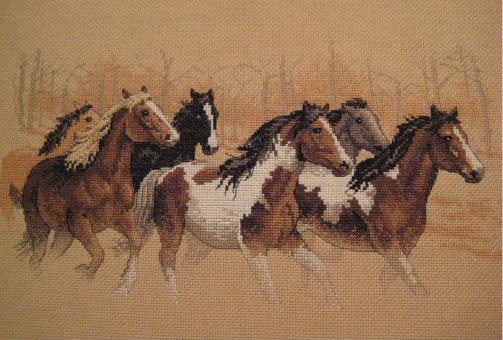
I'm planning on sewing a small blanket made of old shirts that my older brother and I wore when we were kids for my mom. For my grandmothers I'm making a small bar pillow for their backs, and I've just finished a cross stitching of a horse picture for my boyfriend's mom (shown above). Hopefully they all like their homemade presents, I know my wallet sure does!
-Keri Yee
(Blog #1)
--------------
McCall, Ava L. "Speaking through Cloth: Teaching Hmong History and Culture through Textile Art." The Social Studies (1999): 230-36.
Subscribe to:
Comments (Atom)