Sunday, January 10, 2010

# 2 A History of "Uncivilized" Cultural Practices By Tien Dang


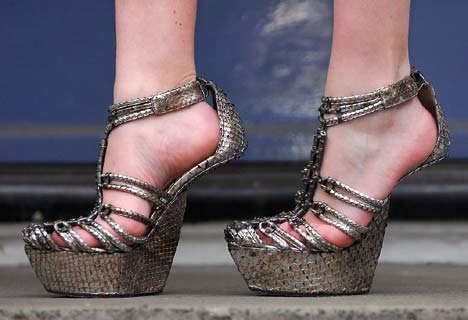
Footbinding seems to be believed as a culturally cruel practice performed by Chinese women. However, I did not know that it has a lot of political connections as well. It was practiced for possibly three different reasons: 1. expressing Chinese wen civility, proving loyalty and differentiating between the Han and the Manchu, and as the ornamentation of the body (Ko, 10). As a female, looking at my feet and the picture above, the first thing that comes to mind is "ouch". But there's also something else that comes to mind: this seems to be a historical thing. Many different cultures have various practices that are documented and analyzed for its vulgarity.

It also seems to be a historical and present fact that cultures practice these bodily embellishments. So to what end is it considered vulgar and barbaric, and what is humanizing?

All I have to say is, I'm glad I had my piercings when I was too young to really be afraid of the act of piercing.

I am in no way condoning footbinding, but I guess I see an underlying question that there seems to be a continuous stream of cultural practice that promotes fashion statements. But to produce what is deemed to be fashion, people must overcome physical pain. Have you ever heard of the phrase "Beauty is pain"? Footbinding is a painful experience, I don't doubt it. But there seems to be different versions of this pain that people are overlooking. So then where does the barbarism end and begin when it comes to fashion? What is society condoning to create this realm and belief of fashion?

Some wear heels until their feet grow numbed and bruised. Some aren't even "walkable" and people tend to limp their way on heels.


For the course challenge, there are a few things I'd like to say: 1. I am not much of a shopper since I hate the crowds and I don't like paying for shipping for online purchases. It's not like I don't shop for myself, but they come in sporadic moments, so thank goodness that sporadic moment passed for me. 2. However, now because I am told I can't shop, I'm more interested in shopping. 3. My brother's birthday is coming up. Am I suppose to buy something used for him? My pocket would greatly appreciate that, but I don't think he'll understand that I'm doing it for a project...

Ko, Dorothy. Journal of Women's History; Winter 1997; 8, 4; GenderWatch (GW) pg 8.

# 1 The Feminization of Fashion by Tien Dang

I'll admit to one thing. Fashion is a concept and it's not style nor is it clothes. But the question still remains. What is fashion? It is a concept, but what kind of concept? I still lack to understand. But one thing is clear to me, fashion has so much implications towards its history and meaning that fashion-ology seems to be a necessity.


The word "fashion" has female implications and is easily assumed to be a female concept. "A major reason why fashion as a social phenomenon has been treated as futile is because the phenomenon is linked with outward appearance and women" (Yawamura, 9). This is generally what women are stereotypically said to be too focused on. There is such a wide range of ads that market towards female consumers rather than male. Thus, further condemning women into a stereotype of domesticity. As fashionology is a new study, it seems to be experiencing the similar impediments that females have had to endured in the past as well as are still struggling with in the present. But what is it about concepts of change and novelty scare people so easily? Fashion is applicable to everyone and as the fashion industry is growing and marketing more and more male consumers, it is also visibly clear that there is a social change growing. Forever 21 and H&M have expanded towards male consumers as well. Although some, like my brother, may cringe at buying clothes at such "feminine" stores, it is nonetheless the reality of marketing and consumption as more and more men are appearing in the fashion world.


As learned in "The Devil Wears Prada," everyone indulges in fashion consciously or unconsciously. Because if fashion was so immaterial, then daily apparel would be unnecessary.

Kawamura, Yuniya. 2005. Fashion-ology: An Introduction to Fashion Studies. New York: Berg Publishers.

The More You Know


Ok so to be outright honest, I had thought that taking ASA 189b was going to be simple, look at Asian fashion and write a paper or two on influences and trends and whatnot. I mean sure we have to look at influences and trends but I had not expected to be made to think of them in any context that applied to me whatsoever, after all I’m an American citizen and I wear “American” clothing.

Oh how naïve I was; learning something meaningful and enlightening in a University?! Good lord! Joking aside, as I was reading through “Re-Orienting Fashion” ed. by Sandra Niessen, Ann Marie Leshkowich, and Carla Jones, I can’t help but feel reflective when I read through their idea of how the West has taken Asian traditional dress and uses it as something chic and stylish. Finally, the world is beginning to embrace each other in kumbaiyahs and sharing of ideas. Yay! Diversity!

But on the contrary, it made me raise an eyebrow that would make the Rock proud. Particularly one line, “Their discoveries were then celebrated in ways that suggested that the people to whom these traditions belonged were ignorant of their worth and hence in need of Western masters to teach them about themselves.” Whoa hold on a minute, my inner activist was burning with passion…ok more of tingling sensation from eating too much spicy foods but nonetheless stirred. No way was the beloved Ao Dai of the Vietnamese people used in such a way, has it?

For as long as I could remember the Ao Dai was the symbol of my homeland. Every year on Vietnamese/Chinese New Year’s I would go to festivals and see pretty girls walk around in Ao Dai and hit on them…um I mean admire them for their elegant mannerism and such, yeah that’s it. Naturally as the Ao Dai began to gain recognition as something more fashionable in the West, I felt a sense of pride. I was happy that something from my country was being seen as fashionable and elegant and most of all worthy of spending ridiculous amounts of money on.

Now this pride essentially lasted up until I began taking ASA classes and now it is best classified as confusion and loathing. The Ao Dai that I felt was representative of my beloved Vietnam was no longer a simple connection to home, but it is tied to the greater colonialism that has plague Vietnam for the better part of a millennium; first by the Chinese, then by the Western powers that be.

While as conflicted as I feel over whether my people’s embrace of the Ao Dai is due to the belief that it is a connection to a home we may never truly return or because it is something that is manufactured by Western ideology, I still think of it in fond terms. Only now it’s rather bittersweet to do so.

Tuan Nguyen

post#1

Citations:

Niessen, Sandra, Ann Marie Leshkowich, and Carla Jones, eds. Re-Orienting Fashion: The Globalization of Asian Dress. NY: Berg, 2003. Print.

Image: http://www.vivisit.com/Upload/48/Nam_2009/Tom_Nguyen/ao_dai_vietnamese_sexy_girl_purple_vnwebsite.jpg

Trickling Down...

My friend asked me what my New Year’s resolution was the other day. The number one resolution listed each year happens to be saving money/spend less, but my shopping habits have continuingly thrown that out the window. It is only the second week of January, and this year’s resolution proves to be no different, a disappointment. I could not help myself and went shopping at the mall yesterday. Once home, I looked at all the goodies I purchased earlier and suddenly realized something: the Compact Challenge. This is definitely harder than you think!

While reading a celebrity gossip website today I thought of Kawamura’s observation of sociology discourses in fashion. So, is fashion a ‘trickle-up’ theory or ‘trickle-down’ theory? The trickle-down theory assumes that “fashions are supposed to trickle down from the higher classes to the lower classes,” (19) whereas the trickle-down theory suggests that consumers influences the construction of fashion. In a society that preys on celebrity gossip and fashion, the trickle-down theory does not seem out of reach. Fashion designers persuade the public (celebrities) of their new designs, celebrities wears them and the mass public goes crazy. But once everyone adopts the fashion, it is no longer desirable. As Perrot asserts, there is nothing more social than clothing (6). Consumers are constantly purchasing the next “it” thing; falling for a company’s marketing tactic or which celebrities are sporting/endorsing it.

As Perrot states, “Clothing reveals aspects of the structure and functioning of societies because it both supports and proclaims the hierarchization, regulation, rigidity- or mobility- of social groups” (16). How credible is the connection between clothing and hierarchy? Everything is mass-produced nowadays so everyone can get their hangs on faux mink.

With clothing being important in social environments, celebrity representation of a company’s brand is also important. Will consumers stop buying Hanes if the company did not take Charlie Sheen off their advertisements? Perhaps. Maybe I'm the only one who thinks this... or is the advertisement with Sheen and Jordan for Hanes LOUSY anyway?

Maggie Chui

Entry # 2

WORKS CITED

Kawamura, Yuniya. Fashion-ology: An Introduction to Fashion Studies.New York: Berg, 2005.

Perrot, Philippe. Fashioning the Bourgeoisie.Princeton: Princeton University Press, 1994.

Image: http://www.unitized.ca/pics/stairs_done.jpg

Image: http://www.enokiworld.com/goods/cardinmarten.jpg

Video: http://www.youtube.com/watch?v=27apfmh5Qw0

Compact Challenge...OMG...


"This make one ask whether clothing is ever truly necessary"
(Perrot)

When I first heard of the compact challenge, I was shocked. Is this for real? So we have to resist the temptation and joyfulness of shopping...This is difficult. I certainly did not sign up for this.

I must confess that i love to shop. There just something about shopping just make me happy. The joy of owning new clothes, new stuffs, and be able to show off to people in our new designer garments. The project make me remember of what shopaholic i have become.
Me=American Eagle + Abecrombie & Fitch + Amarni Exchange + Macy's + Nordtrom
I remember when i was just still wearing Walmart clothes and now look back into my closet...I do not have enough hangers and I still have 3 extra bags marked as : Spring, Summer, and Fall...

I know i will be struggle during this project. But I will participate in this project not only that I have to but I want to. I just need to find a drive for doing so.

I always sees clothes as Perrot wrote in his articles quoting Maurice Leenhard "' neither cold nor nudity led man to clothe himself, but the desire for what would help him toward self-affirmation and self-realization." I keep thinking that clothing defines who I am. They are serving as a symbol of my style and who i am. I would not consider myself fashionable but i dress to define me! I certainly do not follow fashion. When i shop for clothes, I do not look for current trends but rather the clothes that most appeal to me as I was imagining myself wearing it.

People should owns the clothes and work it girl! Strut that catwalk! Be fierce and own it!
( Just adding some amusment to a boring reading)
Anyways, people should not let the clothes to own themselves. Wear what most comfortable and what YOU THINK is best defines you!

Back to the Compact Challenge:
Tips for success the challenge: (Beside the obvious)
-Window shopping...sigh...along with that, avoid malls at all cost! (especially Westfield in SF and San Jose)
-WATCH "Confession of a Shopaholic" and freeze ( yes literally freeze it in the freezer in an ice cude" your CARDS!
-Put money into Mother's saving (which means give extra money for your mom to keep)
-Make a list of NECESSARY thing to buy ONLY!
-Groceries shopping for weekly period (because you do not want to watse money on unused food)
-If you are singles, find a date to get free dinner :D
-Unplug all the outlet when not in use (especially with electronic items with an adapter)
-Stay home and read your reader, focus in school to avoid going out.
-If your house get too cold...go visit your friend or neighbor :D
-And lastly, utilize all resources possible from school because you already paid way too much for tuition.
Have a nice day (window) shopping!


Tu's out!

Tu Le
Blog #2

Citation:
Perrot, Philippe. Fashioning the Bourgeosie. Princeton: Princeton University Press, 1994. p3-25

Image 1: www.reuniting.info/images/manshpg.jpg
Image 2: http://comps.fotosearch.com/comp/PHC/PHC008/man-shopping-bags_~73346692.jpg

Saturday, January 9, 2010

Ready or NOT!


Here it goes… my first out of ten entries in the compact challenge. This is going to be a long, grueling, and hard ten-week “experiment.” When the professor listed items not included in the challenge, like purchasing socks, soap, underwear, and food… I had my fingers crossed. Was I the only one hoping that she would have included clothes, accessories, and beauty products in this list? Or maybe, just maybe, that this challenge was just an early April Fool’s prank in January.

Quite honestly, I probably shop and buy more junk than anyone I know. In my defense, Kawamura states that fashion is “never fixed and ever changing” (4). What's in style today, may not be tomorrow. Is that why girl’s closets are so full? Not to exaggerate, but I am a shopaholic that has been suckered (maybe not) in the consumer culture, and it is a problem I intend not to confront, until now.

I found Kawamura’s section about the female opponent’s argument against fashion to be fascinating. Kawamura states that contemporary feminists feel that “…beauty is that fashion emerges out of the desire to be beautiful, the norm for which is created by men in male-dominated society” (11). I would have to agree more with the female proponents of fashion that fashion playfully transgresses gender boundaries. Fashion plays no role in oppression of women, but influences the way she comes to think of herself. I believe fashion goes for both male and female, and it is likely that consumer culture has influence this consciousness of buy, buy, and buy to look good.

I decided to do Google search on “consumer culture.” In a quick 0.21 seconds search, Google came back with over 57 million links. One of the links that caught my attention was Eartheasy, a sustainable living website encourages people to live healthy, eat well, grow plants, etc. The website had a blog entry about the consumer culture not being an accident. David Suzuki writes, “Much of what we purchase is not essential for our survival or even basic human comfort but is based on impulse, novelty, a momentary desire. And there is a hidden price that we, nature, and future generations will pay for it too.” Maybe it’s finally time we put that plastic card away…

Maggie Chui

Entry # 1

WORKS CITED

Kawamura, Yuniya. Fashion-ology: An Introduction to Fashion Studies. New York: Berg, 2005.

Suzuki, David. “Consumer Culture is No Accident.” 25 Mar 2009. <http://www.eartheasy.com/blog/2009/03/consumer-culture-is-no-accident/>.

Image: http://img.sumotorrent.com/img/shopaholic.jpg

Image: http://www.eartheasy.com/blog/wp-content/uploads/2009/03/consumer.jpg

Fashion: Today you're in, the next day, you're out!


"Fashion put it all on me
Don't you want to see these clothes on me
Fashion put it all on me
I am anyone you want me to be"

In the recent blog, there already a blog been done around this famous song by Lady Gaga. But I believe that we can also look more into the song in a different point of view.

The song was written to accomodate along with the movie "Confession of a Shoppaholic," original book written by Sophie Kinsella. The song solely written to define fashion as a irresistable habits which comes with shopping, spending money, staying skinny and eventually looking fashionable. Therefore, the song mainly introduces us to fashion and answering the question of "what is fashion?"

As we listening to the song, we noticed that they mention many designers names as well as French praises. This indicated the high fashion belong and originated from the French as well as the uniqueness of fashion. In the chorus, the line " I am anyone you want me to be" shows that fashion can transform oneself, or better yet, create confidence within oneself. According to Kawamura, fashion always changes accrodingly to season. Economically speaking, they just make us to spend more money. (Kawamura) When people buy clothes, they are buying ideas, are buying the brands, and are buying confidences. They do not care about fashion but rather care about fitting in with the crowd. I feel like most people wanted to be part of the high fashion so they can feel better of themselves and that become part of the burgeous world or upgrading their status.

As for the artist who sing the song Lady Gaga, she is considered as fashionable. Why? People just have not notice that she just wear what she think is most suitable for her and represent herself. Kawamura also mentions about how these fashion also helps defines yourself through clothing on two simple factor. One: If you follow your own fashion (despite if it is good taste or bad taste which does not matter) then you just found yourself. Two: if you are still copying others and follow the typical quota of what people think you should wear, then...you still need learn and to believe in yourself and trust yourself. Live your life and do what you think is good!

So the question is that: should we or should we not follow fashion? Is there really an answer for this question?

Perhaps not. Fashion is a choice and we decide on what to wear. I higly suggest people to stop building that stupid quota on what people should and should not wear. Trust your senses and ultimately, yourself.

There are much more to talk about the song above so let me summarize some point.
Fashionable=Lady Gaga
Lady Gaga= Unique + Celebrity
Celebrity= Idealistic

Hence

Fashionable=Unique + Idealistic

Hehehe this is basic algebra guys. Take your time

Tu Le
Blog Entry #1

Citation:
Kawamura, Yuniya. Fashion-ology: An Introduction to Fashion Studies. New York: Berg, 2005