Showing posts with label Courtney Lorca. Show all posts

Sunday, June 7, 2009

Being a Conscious Viewer to Be a Conscious Consumer

Television commercials, magazine ads, radio ads, and online ads are all forms of passive advertisement. Viewers watch the television, look or listen to the ads and chooses whether or not to fully comprehend the information being dispersed to them


After reading Minjeong Kim and Angie Y. Chung’s journal article “Consuming Orientalism”, I learned that this idea of passive advertisement is a clever tactic used by businesses to seem as if they are promoting racial togetherness in order “to profit off a multi-racial consumer base through greater inclusion while maintaining White male supremacy through the visual consumption of Asian/American women’s bodies” (Kim and Chung 88). This method is truly ingenious, because they gain the support of different races while secretly disempowering them and perpetuating racial stereotypes (88).


One such example is the Virginia Slims ad in which the Asian woman being featured said, “In silence I see. With WISDOM, I speak” (80). The different races being featured are shown with the stereotypes that the media has forced upon them. While looking at the ad on a surface level, the consumer might be touched at this aim to promote racial harmony. However, with a closer read, one can see the history of racial stereotypes behind each of the women and each of the sayings (80).

But how often do we actually examine the ads we see? Try as I might want to be socially conscious, sometimes when I read magazines or watch television for fun, I don’t always see the bigger picture. I'm too zoned out with trying to relax and get away from thinking. Same with consumerism—how often do we examine our consumption habits? Where we shop from? Where our clothes and accessories are made?


That is what I will be taking from this class and my attempt at the compact challenge … Thinking consciously about everything I do, particularly when I shop. Every time I swipe my credit card, does it go toward a company that treats its labor fairly? Or am I simply contributing to the oppression of laborers all around the world? It won’t be easy, but social justice is never easy. I can’t change overnight, I can’t say that I won’t fail from time to time when temptation creeps up on me, but now I can’t say that I didn’t know better, that I wasn’t educated, that I didn’t already learn about this in class. And the empowerment of that knowledge is what will bring me closer to being a smarter consumer.


Sources


  1. Kim, Minjeong, and angie y. Chung. "Consuming Orientalism: Images of Asian/American Women in Multicultural Advertising". Qualitative Sociology Spring 2005: 67-88.

Courtney Lorca

Blog #6

Lesson Learned


When I was younger, about middle school age, I didn’t really care about whether or not my purses were knockoffs. I just bought them because they had the label, and in the back of my mind, I thought maybe it might not be real because it was so cheap, but I brushed off that feeling anyway. I wanted THE brands, meaning Coach, Louis Vuitton, just to name a few. I was young; my friends probably didn’t know any better anyway. It’s not like they were going to call me out on having a fake Louis Vuitton purse, even when the handle started peeling. Some of them didn’t even know the brand anyway. It just had pretty colors.
Even at a young age, I was entrapped by consumerism … wanting brands I could not afford at the tender age of 12 and wanting to take part in a lifestyle that I’d only seen in magazines and on televison.
Now, if ever I want to buy something designer, I opt to save up (or am surprised on Christmas or birthdays). I haven’t bought a “fake” in quite some time, especially after taking this class and another class on world trade. After giving it some thought, I’ve come to question what’s the point of having a counterfeit good when the “elites” can probably tell which is fake and which is real? I admit that I can’t tell for a lot of brands, but it’s definitely possible if you do your research. Not only is counterfeiting often noticeable, but it “undermines the integrity of business, hinders economic development, and disrespects the rules of competition” (Decker 2004). There are plenty of good designs out there … designs that you could make yourself, even. Why waste the money on counterfeiting when money is so hard to come by these days?


Courtney Lorca

Blog #5


1. Decker, Melissa A.. "Knockouts of Knockoffs: The Global Implication of Fashion Piracy". December 1, 2004.
2. Picture: http://demicouture.files.wordpress.com/2008/04/louis-vuitton-fake-bag.jpg

Monday, June 1, 2009

Reclamation of Youth


As a child, every minute of every day seems incredibly long. All you want to do is what the older kids get to do. You look at adults and see their privilege and begin to wish that you had a job, that you could cross the street to see your friends, and that you didn’t have homework all the time. As you get older, time just goes by faster. But once you realize that you want time to slow down, it only goes by faster.

With the end of another school year looming ahead, all of these realizations come rushing to my head as I try to figure out where the past three years have gone. Every year of college goes by so quickly. It's no wonder that people try so hard to reclaim their youth. This is especially apparent in Japan and the rise of “cute fashion” (Kinsella 225). Sanrio, which began in 1971, started becoming extremely popular with girls and women in Japan. It primarily produced “fancy goods”, which sold “stationary, cuddly toys and gimmicks, toiletries, lunch boxes, and cutlery, bags, towels, and other personal paraphernalia” (Kinsella 226). This trend has carried over into American fashion, as celebrities, such as Paris Hilton, have popularized Sanrio, particularly Hello Kitty.

Sanrio is a way for aging youth to reclaim their younger days. I am one of these aging youth, trying to hold on to every bit of my childhood, even though I took it for granted when I was younger. Buying Sanrio makes me feel like I can reconnect with my younger years … all part of the consumerist culture. I can’t fully reclaim my youth by spending money, but I can pretend!
However, it’s time to slowly move on. Thanks to remembering the compact challenge, I have yet to give in to Sanrio’s ploy to make me believe that I can reclaim my youth. :P But I won’t say that it hasn’t been difficult.

Courtney Lorca
Blog #4

Works Cited

1. Kinsella, Sharon. "Cuties in Japan".

Friday, May 22, 2009

Guilty Pleasures


(Picture courtesy of fashionbombdaily.com)

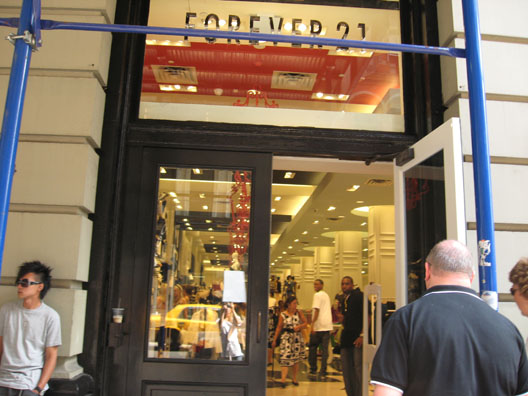
I will admit it. I am a shopaholic. When I see something cute that fits my budget (but I don’t necessarily need), I will buy it. Sometimes even if it doesn’t fit my budget… The main thing for me in my shopaholic frenzy is to fulfill the pangs of desire to have new clothing. Something about having new clothing is an incredible pick-me-up. For someone like me, Forever 21 is heaven-sent. Good prices, good styles… it’s really just about instant gratification here.


Since beginning the compact challenge and through reading more about this retailer, I have found Forever 21 to be less appealing than I previously have. In my “Principles of Fashion Marketing” class, it’s always being presented as the store people love to hate. How can you not love a fashionable store with great prices?! …That is, until you find out WHY their clothing is so inexpensive.


Forever 21 has become more of a guilty pleasure… emphasis on the guilt. Knowing their labor and ethical issues of the past (Byun 1), it leaves me questioning what the current state of their brand is now in terms of labor and ethics issues. Truthfully, it’s difficult to walk by the store with its prominently displayed sale and “Fabulous Finds” signs. Because honestly, those finds are pretty fabulous. It doesn’t help that their business has expanded to include stores such as Heritage 1981, another store I love because of its prices and styles. But with a second look at any of their clothing, one can deduce how cheap the material is and find it to be disposable and not likely to last long. Same with the trends, so maybe Forever 21 is actually practical in some sense. The designs are trendy and cute, but fashions last only for so long.


This again employs the theory of trickle-down. Lower classes, or people who don’t want to pay a lot of money for expensive, trendy clothing, instead buy cheaper clothing of the same design but lesser material. Fashions are trickling down from high quality high fashion, to high fashion low quality. Fashion is being recycled because it takes longer to get from the fashionistas and trend originators to the masses and the stores like Forever 21, which is where many people shop (Kawamura 19).


Each of us is wearing Forever 21 in this picture ... it's inescapable.


Courtney Lorca
Blog Post #3
  1. Byun, Chuck Q. "Forever in Trouble?". New American Media April 4, 2003.
  2. Fashion-ology: An Introduction to Fashion Studies by Yuniya Kawamura

Sunday, May 17, 2009

Pilipino Culture Night


Last weekend, I participated in Mga Kapatid’s 22nd Annual Pilipino Culture Night, also known as PCN. PCN is a beautiful celebration of the Pilipino culture through music, dancing, and acting. You can get a taste of the Pilipino culture through this yearly production, (although after doing the research for our paper, we know that the dances really only give just a taste, rather than the whole experience!). This year’s PCN paid tribute to the World War II veteranos who fought for America alongside American soldiers, but still haven’t received the full equity that they deserve. Cultural, ballroom, and modern dances were interspersed between the scenes.


I had the opportunity of being a part of acting and a Spanish-influenced dance called Paseo de Iloilo. I am proud to say that I followed the compact challenge through my costuming because I reused a dress I haven’t worn in a couple of years for my main acting scene, I borrowed pants and shoes from friends for a battle scene, and my costume for the dance consisted of a white shirt with a skirt already provided by the production itself. The skirts we used were from the previous year. The material was nice, but they fit the people from last year, so we all had to make many adjustments. This is like the trickle down theory because the higher classes got the better fit, and we had to make do with what we had (Kawamura 19).


Courtney Lorca
Blog Post #2


1. Fashion-ology: An Introduction to Fashion Studies by Yuniya Kawamura

Sunday, May 10, 2009

Whole Earth Festival

This past weekend, I attended the Whole Earth Festival on our campus. The mission statement of the Whole Earth Festival (from the website) is: “to envision and create a community driven festival of education, music, and art. … We want to develop a conscious community that will go out into the world after the festival and encourage the values that we hold dear. We are all equal participants in the conscious creation that is the Whole Earth Festival.” In order to cultivate this kind of environment, there are a variety of food booths; instead of using disposable utensils, they encourage the use of multi-use utensils and have a receptacle where the dishes can be washed. There are also many different kinds of clothing and accessory booths, which are among my favorite parts of the festival.


This particular booth (pictured left) sold clothing made of recycled silk. The clothing (scarves, tops, and full-length dresses) ranged from $15-75, depending on the item of clothing. Silk is a treasured commodity, and clothing made of real silk is usually expensive. By recycling silk, quality clothing can be made at a cheaper price. This concept of reusing expensive material for cheaper prices is shown through the trickle down theory, “where fashions are supposed to trickle down from the higher classes to the lower classes” (Kawamura 19). Not only are the fashions trickling down, but so is the material being used. By the production and consumption of clothes made from reused silk, it is a way of being not only a green consumer, but a smart one as well.


Courtney Lorca
Blog #1


Sources:


1. wef.ucdavis.edu - Whole Earth Festival website

2. Fashion-ology: An Introduction to Fashion Studies by Yuniya Kawamura