Sunday, December 2, 2012

The New Fashion Gatekeepers


Sharon Lin
Blog #5


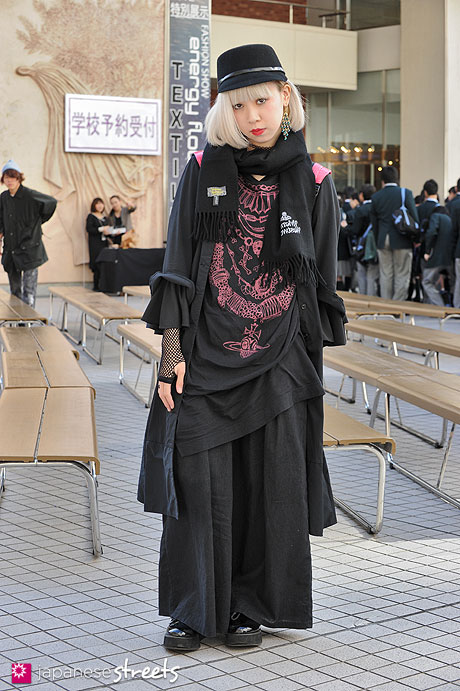
AKI

STUDENT, 18

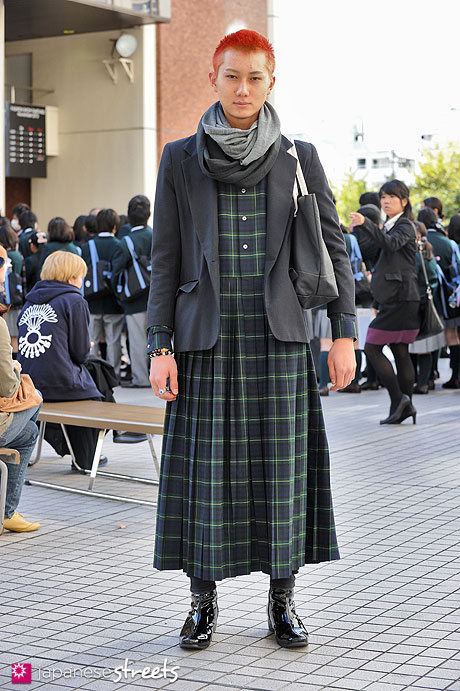
SHOHEI MINAMI

STUDENT, 19

EMO


STUDENT, 16

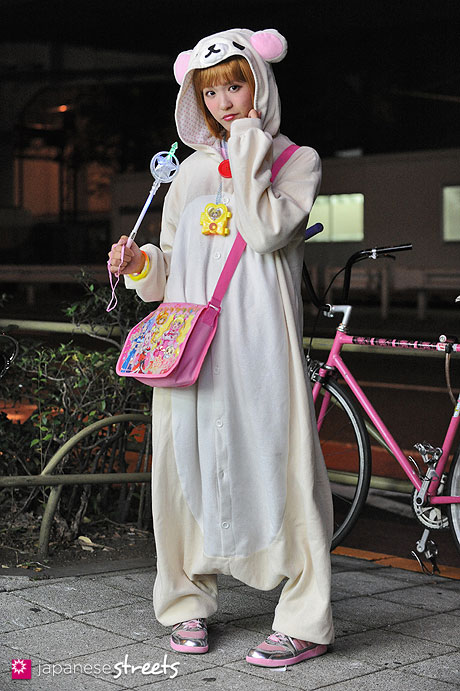
Kigurimi (cartoon-character costume) – (bought at San X)
In the past fashion gatekeepers have always been professionals in the fashion industry. Fashion editors and professionals that were trained and educated in top fashion institutions have dictated what is fashionable and ultimately, what people will wear. In Japan, however, this trend has reversed itself. Japan’s gatekeepers often are not even old enough to have a formal fashion education. Japan’s most popular fashion stems high school-aged sales girls in boutiques and shops on the streets of Shibuya and Harajuku. This phenomenon is evident in Japan Streets, “the longest running English fashion blog about Japanese fashion.” The blog spotlights different outfits found on the streets of Japan. A large majority of these ‘featured’ outfits are outfits of students hanging around Shibuya.
            This new type of fashion trendsetting is fascinating, considering how fashion tends to be disseminated in the United States. In the US, designers become “famous” and popular when their work is seen on celebrities and people of top class. An example of such incidence is the work of Jason Wu. After his dress was seen on the elegant Michelle Obama at the Inaugural Ball, his fame skyrocketed. In Japan, however, the fashion industry seems almost to have evolved into a democratic system where the majority “wins” in terms of fashion trends. Consumers have become an indispensible part of the fashion industry in Japan where “those who come to shop also play a crucial role in the production of fashion trends…The teens’ opinions and voices are reflected directly in their merchandise selection” (Kawamura 193).
            Personally, after seeing the results of Japan’s new fashion gatekeepers, I prefer the way that fashion is disseminated in the United States. Whenever I look at Japanese fashion, I find it difficult not to see their clothing choices as avant-garde. The gothic Lolita style, the Gonguro style and the Mamba styles all make me cringe. I do not find any of the aforementioned styles, which have been wildly popular in Japanese street and popular culture, beautiful in any sense. The gothic Lolita style scares me and confuses me, the Gonguro style gaudy and the Mamba styles all look like clown make up to me. Beyond pure aesthetics, however, the Japanese fashion industry’s ability to truly use fashion as a tool of expressing identity fascinates me. In the United States, we say that our clothing choices reflect who we are and how we identify, but rarely do we actually truly identify with and gather with people with styles similar to ours. If anything, much of US fashion is the same at its core and merely has different variations. In Japan, however, each style is unique in its clothing choices but also in the interests the people of that group possess or how they identify. In Japan, the look reflects a lifestyle.

Inside Source: Kawamura, Y. "Japanese Teens as Producers of Street Fashion." Current Sociology 54.5 (2006): 784-801. Print.

Outside Source: Web log post. Japanese Streets. N.p., n.d. Web. .


Be Green Challenge Update:
            The Be Green Challenge has finally come to an end. When I woke up this morning and realized it was December 1st I screamed with delight that I can finally buy things again!! But, it’s been a full day and I still have not made any purchases. The challenge has become a habit. A good habit. I will probably purchase something soon, but I have definitely learned to be more conservative in my consumption of unnecessary retail items. Aside for the minor hiccup on Black Friday, I have not purchased anything else this month. This is a feat, although, not completely successful.


Saturday, December 1, 2012

Luxe


            In this week’s reading of “Fashion as an Institutionalized System”, Kawamura explains that hierarchical structure of fashion is democratizing and becoming more fluid within the economy. She goes on to say that luxury goods are becoming easier to obtain. I agree on this because places like outlets and discount clothing stores like Nordstrom rack, Marshalls, etc. are everywhere in America. This says something about capitalist societies like America. Even people who do not earn a high income are able to afford things like seven jeans and Gucci bags designer discount stores. Consumers are too obsessed with luxury items just because they want to be seen as a person with high status. I’m a college student and I go to Nordstrom Rack for their designer’s jeans and shoes, but they have everything ranging from Burberry watches to Gucci shoes. When you go to these stores, you don’t have to feel a sense of intimidation you would get from a Designer boutique. Anyone can have access to the designer’s clothes for a more affordable price from these stores.


            In the article “Off-Price Nordstrom Rack Opens To A Crowd, But Will It Last?”, Janice Podsada talks about how there is an increase in demand for off-price Nordstrom Rack stores and less of a demand for the full line Nordstrom store. Nordstrom Rack offers clothing and merchandise from Nordstrom stores at up to 60 percent off original prices offered specially for Nordstrom Rack at 30 percent to 70% off. Many are intrigued by affordable prices for designer clothes. Nordstrom Rack has been doing so well that they recently updated there checkout methods. Instead of lining up at the cashier, there are now kiosks around the store to check you r merchandise out via iPhone.


Update:
I am pleased to announce that the last week of the Be Green Challenge is coming to a conclusion. I have consistently struggled day to day about the basis of my shopping urges and decided that it is due to vanity and an effort in increasing diversity in my wardrobe. I did not buy anything this week besides food and alcohol.

Mable Ng
Blog Post #5

Inside Source:
“Fashion as an Institutionalized System.” Fashion-ology

Outside Source:
PODSADA, JANICE PODSADA. "Off-Price Nordstrom Rack Opens To A Crowd, But Will It Last?" Hartford Courant. Hartford Courant, 26 Apr. 2012. Web. 01 Dec. 2012. .

Sunday, November 25, 2012

Blog 4: Japanese Schoolgirl Style


  In the article, Japanese Schoolgirl Inferno by Marcias and Evers looks at the different styles of Japanese schoolgirls and attempts to identify key factors that make up each of the girls outfits, and documents interviews with the girls. First, we have the Takenokozoku girl from 1979, and she wears this almost pajama-like outfit, and carries a boom box and whistle everywhere with her. What I find even more interesting is that, ”Takenokozoku influence appears in the air whenever packs of kids gather to hang out in Harajuku” (Marcias, Evers 30). That even though their style maybe way in the past, it is still very popular among the youth. Then we have the Lady’s, and they sort of remind me of that cool crowd of girls at school, that were so cool and smoked cigs. Sort of like the Pink Lady gang from the musical Grease. Except the Lady’s had purple eye shadow, and rode motorcycles. The Kogal girl is more so of the typical scoolgirl that is seen in manga and anime. They wore the schoolgirl uniform, except the skirts are too short and their socks were so long that it made Sailor Moon girls look stuffy.  The list goes on and on from girls with Jersey Shore tans and Barbie doll like hair to Gothic Lolita girls, which goes to show us the wide variety of styles that Japanese girls participate in. Blogger Danny Choo from dannychoo.com writes, “Lucy Pop do everything one would need to transform themselves into a fully fledged school girl” almost to showing that the Japanese schoolgirl is a costume, or a being that people are willing to play dress up, and pretend to be for a Halloween night.

Source: http://www.wordpress.tokyotimes.org/?p=3000

Source: http://ladiescoco.blogspot.com/2010/11/makeup-tutorial-for-harajuku-ganguro.html

Be Green Update:

  I SURVIVED! (I Will Survive plays in the background) This weekend is what many people know as Black Friday, the biggest weekend dedicated to shopping in high volume at heavily discounted prices.  I do feel a bit terrible that my mom told me to wait in line at Best Buy to get a new digital camera, but it was because the one we have is dead and she wants one so she could take pictures of me for when I walk this December! Almost done with school! While I was at best buy, I could see these hungry techies and families salivating at the awesome deals they could score on TVs, laptops, and whatever else they could get their hands on, sort of disgusting. It makes me feel gross just thinking about how I used to be about sales. O while everyone was grabbing their black Friday steals, I went digging in my closet, and I find an old grey sweatshirt and circle scarf, never worn, and in great condition. Almost done with the challenge, and I’m feeling good.

- Krizia

Self-Exoticizing or Empowering?


Sharon Lin
Blog #4


"Self-exoticizing"
What does it mean to exoticize oneself? When I think of self-exoticization, I think of people of minorities in work that utilizes or sells one's body, for example, models. I never would have imagined that national dress could be mixed into self-exoticizing.
            In Ann Marie Leshkowich’s article, “The Ao Dai Goes Global: How International Influences and Female Entrepreneurs Have Shaped Vietnam’s National Costume,” she writes about the process that often must occur for national costume to be accepted and popularized in Third World countries. She take the example of the ao dai and its re-popularization after it won the prize for “Best National Costume” in the Miss International Pageant. Leshkowich argues that oftentimes, national costume is another place of Western influence and Western imperialism. The perception of a national costume is where “a domestic context in which national identity, images of traditional femininity, the lure of international power, and the simultaneous desire for “local” authenticity and modern cosmopolitanism mingle” (Niessen, Leshkowich, Jones 86). In the case of the ao dai, it became popular after the Miss International Pageant because “young, urben Vietnamese women and the media [saw] and newly [appreciated] the ao dai as outsiders might” (Niessen, Leshkowich, Jones 86). The process of seeing the national costume through an outsider’s eyes and deeming it worthy because of an outsider’s approval is the process of “self-exocitization.”
            I argue, however, that self-exocitization does not only happen in the Third World. When we look around at the fashion and consumer culture in America, there have been many times in the past where Asian national costumes were popularized by the West and then accepted not only in the West, but also all around the world. The national costume most popularly exoticized in the West is the kimono. In a recent controversy with Victoria’s Secret’s “Go East” lingerie collection, it is evident that the national costumes of Asia are still exoticized. One blogger, Nina Jacinto notes, “When a company takes it one step further by developing a story about how the clothes can offer a sort of escape using explicit sexualized and exploitive language, it takes the whole thing to another level. It’s a troubling attempt to sidestep authentic representation and humanization of a culture and opt instead for racialized fetishizing against Asian women.” In Japan, the kimono is worn with pride. After an interview with an Asian American designer for my paper, I was forced to question whether or not this pride comes from within the Japanese culture and valuing the beauty of the kimono and whether or not the Western acceptance of the kimono has any influence on the pride that is in wearing a kimono. Victoria's Secret was not the first to use the kimono in modern fashion and it most certainly will not be the last. 
One question that I feel is neglected in Leshkowich and Jacinto’s arguments, however, is whether or not donning our national costumes is truly “self-exoticizing” or can merely be empowering? When Asian Americans wear a kimono, to them, it may not symbolize exoticization, but rather, grace, elegance and beauty that is embedded in the Japanese culture. Who can say what the person wearing a kimono feels and where from their feelings are derived?

Inside source: Niessen, S. A., Ann Marie. Leshkowich, and Carla Jones. "The Ao Dai Goes Global: How International Influences and Female Entrepreneurs Have Shaped Vietnam’s National Costume." Re-orienting Fashion: The Globalization of Asian Dress. Oxford: Berg, 2003. N. pag. Print.
Outside Source: Jacinto, Nina. "Victoria’s Secret Does It Again: When Racism Meets Fashion." Web log post. Racialicious. Latoya Peterson, 6 Sept. 2012. Web. 25 Nov. 2012.


Be Green Challenge Update
This past weekend was the biggest challenge. I was determined to beat the challenge and not buy anything this Black Friday. I thought it would be easier than it was, and in the end, I unfortunately caved to the temptation of sales. In my defense, however, I only bought things that were on sale and at the, I only bought 2 items that were solely for myself. 
My downfall was gradual. Every year my friends and I go Black Friday shopping together. We go the morning of to salvage whatever is left of Black Friday because, well, we simply just value our sleep during break too much to go any earlier. This year, my friend asked me to accompany her because our other friend was busy. I gave her the disclaimer that I could not purchase anything for myself, but that I would go with her. I was fully committed to upholding the challenge. When I got home, however, I discovered that my sister, in her procrastination had not yet finished her college applications and would not be able to go Black Friday shopping this year. She asked me to shop for her while I was with my friend. My resolve began to crumble. The opportunity was simply to good to turn down. Since my sister is about the same size as I am, I knew I could buy clothes that I would like but just have her have it until November was over. I had found the loophole! It would be like shopping for myself except I would not actually be buying anything for myself. As one can imagine, this loophole was merely a slippery slope into buying things for solely for myself. 
The day of Black Friday, I started off determined. I bought only things I thought my sister would like. Then we hit H&M and I bought things I thought my mother would enjoy. It was at Forever 21 that things took a turn for the worse. (That darn Forever 21!!) The regular sale did not much tempt me. 30% off sweaters was a nice discount...but not nice enough for me to really consider it. What hit me the hardest was the additional 50% off sale items. Some pieces were only 2 or 3 dollars! I couldn't resist. (I know, I sound like a ridiculous shopaholic…) At the end of the day I came away with two pieces solely for myself. 
I am fairly disappointed that I wasn't able to last the entirety of November without purchasing something. I like to think, however, that had it been any other month, I would have cruised through the challenge. Maybe I'll try the challenge on my own sometime (in a month other than November and/or December) and see how well I fare. I think I could succeed if it were any other month. 


The Power of Consumerism


Mai Moua Vang
Blog #4

Inside source:
Parminder Bhachu. "It's Hip to be Asian."

In this week's reading, people from the U.K., white and Indian people, commodified the Indian culture and how it is seen through the eyes of globalism. While I was reading this piece, I thought about the film we watched in class. I don't remember the name of the film, but it was about Hispanic people in Los Angeles pasting Aztec symbols onto shirts and selling them to mainly white people from the U.S. and several European countries (and some Asian countries as well). Since there are so many diasporas located around the world, especially in big fashion-driven cities, it is very appealing to sell to people things that are different and exotic. The author, Bhachu, points out that the consumers are middle-class, regardless if they are white and Indian. Since many of the salwaar-kameezes, or traditional garments worn by Indian people, are authentically made by Indian people, it shows how much power the Indian diaspora in the U.K. has because they are the ones who are determining what is in fashion in the U.K. and those in India make what British people (affluent white and Indians) demand for. 

Outside Source:
http://www.ibtimes.com/black-friday-2012-online-retail-sales-rise-26-104-billion-comscore-898674

In the Internet world, Black Friday, November 23, is the highest profiting day in the year. It rose 26% from last year ($1.04 billion this year from $816), also breaking the billion dollar mark. The top five companies (in order) that profited from that day is Amazon, Walmart, Best Buy, Target, and Apple. 

I thought that it was interesting how Walmart employees are on a national strike, yet they are were the second highest profiter of Black Friday--how do people and those who bought stuff there feel about this? Walmart employees are on a strike! They are people just like you!?  I just don't know how to feel about this. This speaks loudly the strength of consumerism and it makes me quite sad. Humanity, what's wrong with you?!


Update on the compact challenge:

The challenge is going ok. This weekend was Hmong New Years in Sacramento and I really wanted to buy some Hmong-inspired clothing from the vendors, but since this challenge is still happening, I just have to wait until the New Years in Fresno. It's not that long of a wait since it's during Christmas break. I'm still spending money but all of it goes to food. I'm running low on my foundation and it's a shade that doesn't match my skin tone so I don't feel that great wearing it in public. The expiration is coming soon too and I hate wearing bacteria-infested products on my face. So glad this challenge is ending soon!

I didn't go to Black Friday but it had me thinking about all the laborers from developing countries. They must hate and love this time of the year since they have to work A LOT to meet the extra demand from the holiday season. I hope they get to buy nice things for their families too. 

Remembrance


Danny Liemthongsamout
Entry # 4

As I age I've noticed everyone around me accepts what we are.  We realize our gold teeth and clothing will never be accepted.  People dress urban as a fashion trend when they never came from urban communities.  As I pass as a normal person, my life and who I am will never be able to pass.  Kawamura states," Fashion in a postmodern times emerges out of youth culture and is then commercialized by the industry to reach a wider audience to spread it as a 'fashion'." (799)  Stick up boy clothing is imitated in fashion but few remember it's origins and meaning.  Many people represent their communities but aren't actively involved in the underground and movement of their communities.  I guess I pass now because there is no reason to prove what I am.  It isn't the clothing, but if people knew who I am, how I live, and the community I come from, they tend to judge.  It's game recognize game.  People forget hip hop fashion comes from real live youth cultures.  It is something for a culture to evolve influenced from the philosophy and legacy of other cultures, but I feel there is a sense of cultural appropriation in Japanese clothing.  The aesthetics of clothing becomes more important than the meaning.  Losing the meaning of patterns in Lao traditional clothing creates fashion with a fragmented connection to it's own history, influence, and purpose.

http://youtu.be/kcHaIGMtNYQ?hd=1&t=1h28m42s

I don't know why, but lately I fell a sorrow when I see hip hop fashion.  I see a different kind of beauty connected to my memories.  I remember violence, robberies, and cars.  I remember days in the hospital and the smell of gasoline.  People don't realized the base of the clothing in my community is poverty.  Poverty and it's consequences permeate into all aspects of our lives.  It's a life of survival and I carry stories and wisdom of people who didn't make it.  Watching "My True Friend", it reminds me how putting on clothes reminds me of people.  It reminds me of a time in my life.  Maybe this is how my elders feel seeing traditional clothes.  It reminds them of another time and many people who never made it.  I actually feel emotions.  I feel sorrow, sadness, happiness, joy, loneliness, and comfortable at the same time.  "Sabai Sabai" is to be at peace.  Peace isn't forgetting pain or embracing happiness.  Peace is fully feeling sorrow and happiness.  I guess the sorrow I feel putting on clothes in the morning makes me smile.  Lao people never cry at funerals, because we do not hold on to death but to the beauty of peoples' lives. 

Update on Be Green Challenge:
I lost count on how many cigarettes I smoke.  What am I coping with?  I look at my life and know but it's so much to confront.  There is something wrong.  There are things wrong in this world, because I know in my heart the way the world is and the way I live shouldn't be considered normal.  I've never worried about life or a career.  I know I'll struggle and sacrifice.  Will I sacrifice my body to labor?  Will I sacrifice my mind to academia?  Will I sacrifice my heart to the streets?  My life has always been hard and I know it will not get easier.  It's stressful to go from hugging our son and then aiming a gun at people.  It is a life with too much emotions.  It is a life with too much struggle.  It's the only life I have and my community has.  I never thought I would care less about clothing as I aged.

Kawamura, Yuniya. "Japanese Teens as Producers of Street Fashion." Japanese Teens as Producers of Street Fashion. N.p., n.d. Web. 24 Nov. 2012. .
My True Friend. Atsajun Sattakovit. NA. 2012. Film. <http://youtu.be/kcHaIGMtNYQ?hd=1&t=1h28m42s>