Wednesday, December 5, 2012

Final Thoughts

 
          It is December and the Be Green Challenge is finally over! Having the Be Green Challenge in the month of November was torture because there are so many temptations for me to shop. My housemate’s birthday was in the middle of the month, Thanksgiving was coming up so I wanted to get things to make me look sharp and spiffy, and black Friday and cyber Monday were also in the month of November. I found myself finding excuses to go and shop throughout the whole month, but fortunately November consisted of a lot of laziness as well so I was too lazy to step out of the house.
             I failed this challenge on Black Friday went I found out that stores opened at 12AM in downtown San Francisco. I blame going tipsy shopping because it made me become so easy going about shopping and purchasing. The deals were so good that I couldn't resist. I succumb too to the cheap sales. “50% off Sale prices” at Urban Outfitters just killed my challenge. I didn't re purpose or DIY anything this month so I didn't follow with my initial plans to not spend money.
            I failed this challenge because I succumbed to the temptations of a shop-a-holic. I consistently wanted new things for myself like new clothing or even a new toothbrush. I always found myself making excuses to make a run to target or make an excuse to go to the mall. This challenge helped me realize my weaknesses as a consumer in this capitalist society of America. I am very vulnerable to advertisements and vanity. I think that it was a great idea to have this challenge held in the month of November because it helps me see the intensity of my shopping habits. November is the time of spending and corporate ploys to make consumers buy buy buy so the effects of this project are way more prominent than if it were to be done one any other month (except December).
            This project gave me new perspective on my spending habits and I will use this experience and apply it to the future. I will always be aware of spending and the reasons behind my urges. I think every consumer should do this challenge because it helps puts things into perspective.

Mable Ng
Blog Post #6

More Than Meets The Eye

Steve (Shing) Li Blog #5


Finishing the book "Fashion-ology" and reading the conclusion I can say that it really wrap it all up really well in terms of telling us what fashion is about. How so called "designers" don't play a specific role in creating the garment, instead they are the ones that create the image and also the brand and name for themselves. Designers in mid-nineteenth century did not even have their name publicly know (65). Now designers not only control the fashion industry but are also very famous and have acquire a status that only few can achieve. As a result, fashion really has a lot of more depth than it meets the eye.  Fashion not only deals with clothing and garment but also deals with the social economic status of the social climate, the hierarchy of individuals and there is a power play between who gets to decide the next trend from top - down to bottom - up.


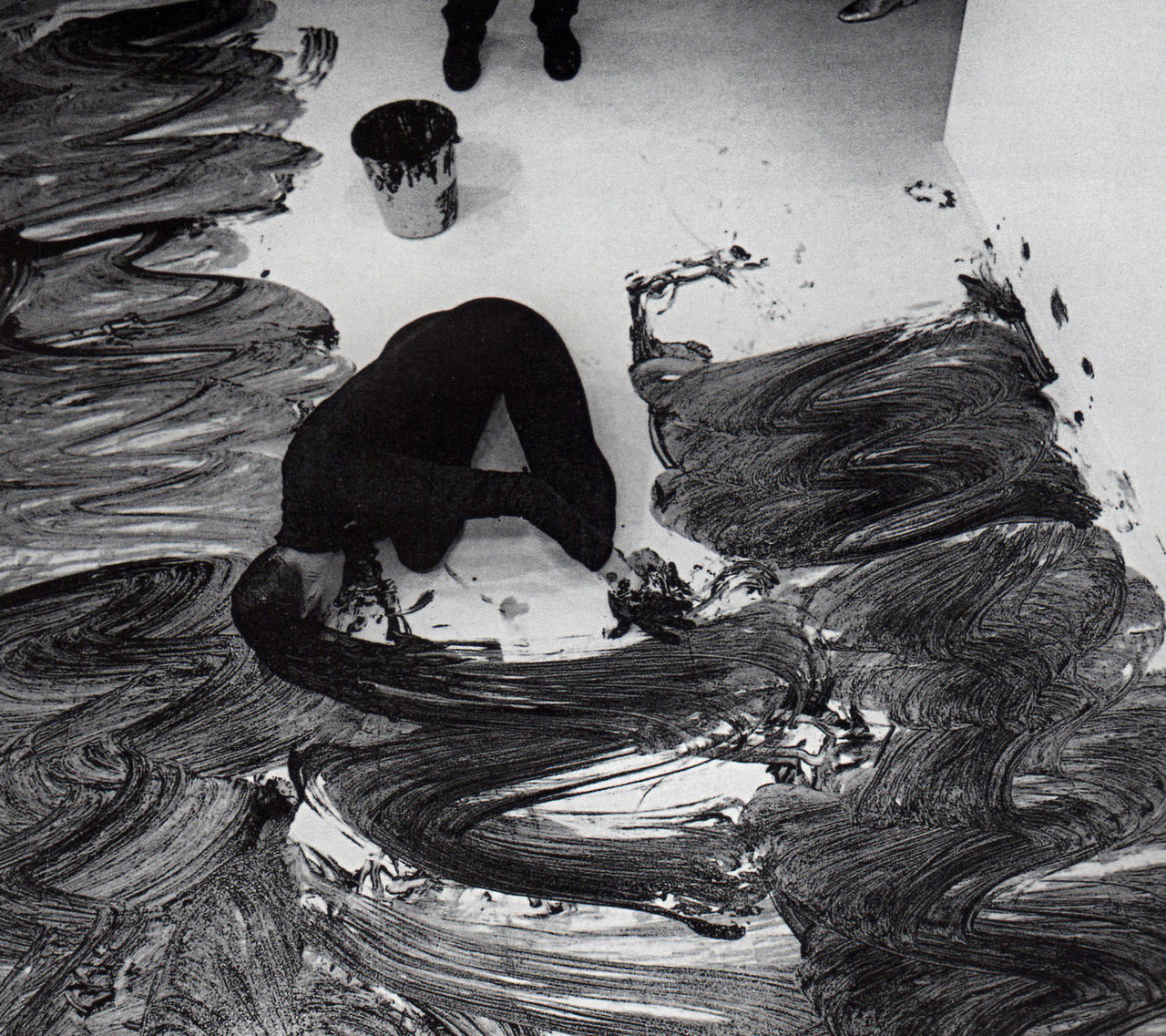
Janine Antoni Loving Care 
“I mopped the floor with my hair…The reason I’m so interested in taking my body to those extreme places is that that’s a place where I learn, where I feel most in my body. I’m really interested in the repetition, the discipline, and what happens to me psychologically when I put my body to that extreme place.”

While I was surfing online I found this very interesting picture of an artist who uses part of her body in order to create a piece of art. In this instance she uses her hair as a mop in order to feel this out of the ordinary experience. Looking a this picture it was very though provoking and it made me think of the different extremes that artist go to in order to satisfy their imagination and how this relates to creating fashion and new pieces of clothing and what inspires them to create that image.


Be Green Challenge Update: So far I have not brought anything after black friday and it has made me realize how much money I'm spending on rent and food and that I need to get a job as soon as possible!

Inside Source: Kawamura, Yuniwa. Fashion-ology: An Introduction to Fashion Studies - Conclusion. Oxford: Berg, 2006. 106. Print.

Outside Source: Garzon, Martha. "Contemporary Art." Contemporary Art RSS. N.p., 1 Oct. 11. Web. 05 Dec. 2012.

Sunday, December 2, 2012

All over the world

Racheal Rhee
Blog 4

Inside source: "Fashion as an Institutionalized System" in Fashion-ology


From early on when fashion began to rise, only certain people wore haute or couture which were designed for individual. In modern days, however, there are ready to wear designer wears produced in mass production. Famous fashion designers originating from Paris, Japan inspire other designers in different country. However, a lot of other country still show interest towards famous designers from Japan, and other areas.


From this picture shows modern Korean fashion with the model wearing Yohji Yamamoto's clothing line. In ultimate conclusion, many countries that are industrialized, still tend to adopt and launch famous designers from different areas instead of searching for local designer and artists. 

Outside Source:  Thrift Shopping Boho Chic: How To Match A Runway Style

I saw a video of Sammy Davis, one creative lady who decided to make a website to better the knowledge of people regarding to selling and buying worn clothes in a fashionable way, matching the runway style. 


Her chic Boho style comes from Goodwill store, a thrift store that can be found in local areas. Goodwill store's clothings are donated from local areas to resell for the purpose of providing affordable clothing, reduce consumerism, and to offer jobs to unemployed minorities as workers. It's quite amazing to see how Sammy's creativity can affect many people into shop from thrift stores. 


Blog 5: What A Showoff


While reading the Conclusion section of Fashion as an Institutionalized System in the book Fashion-ology by Yuniya Kawamura put what I thought of what fashion was, and turned it upside down. What I thought of fashion when I was younger; I thought of it as something so frou-frou and too strange for me to understand completely. Granted I was very much a tomboy at the time (14 years old) and had little to no interest in fashion. The author states, “the motivation to attain it based in the desire to make a slight difference with others because luxury items provide a sense of superiority as an image and added values are attached to them” (Kawamura 55). I agree with Kawamura because it happens all the time, even though we know that there are several girls on campus that have the same purse, there is still is this fascination that if you have this certain bag, that you are automatically placed at a higher status compared to the average college girl. You know what I’m talking about, those girls that have the Louis Vuitton Never Full GMs. Once we see that, it means that that girl is rich, important, and high-class, because that purse is expensive, popular, and they only use the best materials when constructing the purse.  Fashion does that, it creates the in and the out of season.

Source: https://blogger.googleusercontent.com/img/b/R29vZ2xl/AVvXsEivyLUi7lkH-TRHxv34ca5LyoFZlCdkIliE2WZlk-sWoB4lCCcF_5NyxECwzdhj28t2Kh3yCU56Hl2hT6tpuijN4FkCPu_tznhmhTurwg-cclYHNVxajuJxQD1on8fAPNfvQttrPaDM9A8/s320/Handbag+comic.jpg

Blogger Constantious Charalambous of everyday-economist.com explains the obsession of women purchasing fake designer bags in So You Want To Buy A Fake Louis Vuitton?  He states, “this need can be broken down into two factors: taste and showing off” (Charalambous 1).  And that in order for lower classes to be accepted by the upper class, they buy a fake designer bag to show that they can be included in this high class group of people. The value placed on this designer bag is so high that if they were caught with a fake, they would be in utter embarrassment.

Be Green Challenge Update:
Not going to lie, this was really difficult, but I feel good. I have looked into buying secondhand clothing, and All Things Right & Relevant in East Davis has some pretty good sweaters to add to my closet. I think that it has been a telling challenge to show that I can go without purchasing something new for a month. I have been looking in my closet and I am happy with what I have, and even donated old clothes that I do not fit into anymore. It has been a great experience, and I will think twice when it comes to compulsive buying, now I understand what it means to save my money for things that I actually need.

- Krizia


Blog 5

Hue Thao
ASA 141, Blog 5

I totally forgot we were still doing this...are we still even doing this? Well, 5 weeks of not purchasing any goods went well for me, except the tires. To be honest, I am not even sure what we are doing anymore. I'm more focus on finishing up with my research paper. On the side note, I have a friend who is a writing tutor at Dutton Hall who is helping me with my grammar for this research paper. Yes Valverde, I will do my best to get you a coherent paper. Also, I was thinking, I believe my paper is pretty interesting. Therefore, I am only giving you what I need to for the quarter. You won't be able to see the full book, but at least you see the first chapter...see what I did there? My paper will have the amount of your requirement, but ten pages is not going to be enough to write everything my dad and I have to say. Thus, I am inspired to continue writing this paper even after this class end. Maybe you can help me turn it into something bigger along the way, just a thought. I want to be able to turn this into at least 30 pages. :)

Back to topic, the Green Challenge is pretty much over with I think. I have not bought anything this whole time. It hasn't affected me at all, but I feel that this made me realize how much I waste on food. Aiya, the life of a college student is crazy. I am not sure what else to blog about...hold that thought. I remember that we were here to speak about fashion. On the bus the other day, I overheard these African American ladies talking about the movie Good Hair. I somewhat laughed because we were just watching the film. Also, the Art reflection paper was suppose to be written, but there is no clear advice from the syllabus so I will just write what I thought about the last few minutes of the presentation that I saw. I'm just going to leave this blog and end it with a word from Grandmother. "It is enjoyable to eat something delicious, but the greatest joy is the time spent waiting for it."


Coming to Terms

Danny Liemthongsamout

Entry # 5

Kawamura states, "Fashion-ology deals not only with individual but with the social institutions of the fashion world and their effects upon the social and economic status of many individuals when fashion is used as a symbolic strategy." (Kawamura, 105) I realized my family and friends are all stick up boys.  My mother never questioned my bright colors or when I wore gold grills.  My family and relationships based on understanding and closeness allows us to wear our traditional skirts and clothing without judgement even from friends who are not Lao.  This respect and understanding allows us to understand each others cultures and cultural food.  I believe fashion is powerful as a representation of a group values and my family with the value of respect and understanding allows us to transcend notions of appropriate fashion in U.S. society.  I believe this is true in Japanese culture too.  The importance of family transcends into fashion and binds fashion to cultural norms but also allows respect for individuals to dress as they would like.

"Bitch Bad" by Lupe Fiasco is his discussion of of the reclamation of the word bitch and how it has a negative meaning and a positive meaning.  This is something the word black and queer went through also.  I realized there is a reclamation of the words gangster and mobster, because the community of people considered gangsters and mobsters exists.  There exists cultures, values, and morals also.

Update Compact Challenge:

I still haven't bought anything except cigarrettes.
I probably won't buy clothes for a few years. I already have two rooms full of clothes.

Blog 5


Natsumi Moudry
Blog 5
12/02/2012

Inside Source: Yuniya Kawamura. “Japanese Teens as Producers of Street Fashion.” Reader.
Outside Source: Shouno, Yusuke, Natsumi Fujita, and Kurando Furuya.Frontline of Fashion. Irifune Chuo-ku Tokyo: BNN, 2009. Print.

In class we watched a documentary about the making of Vogue magazines. From this video I learned that fashion in America is usually top down or trickled down from higher classes to lower classes. Anna Wintour, the editor of Vogue, makes the final decisions of which photoshoots get included in the Vogue magazines, whether there are others working for Vogue who disagree with her decisions or not. In class, we discussed how Anna Wintour has much control over what the trend is for any class because many of the designers in America imitate the styles shown in Vogue.

Despite having imitation from higher classes to lower classes in America, Japan has a different direction in their fashion. In Japan, the youth in the streets usually set the fashion trend (Kawamura, 784). In the past Japan has been viewed as very conservative in their dress, but from the 1990s Japan’s economic system changed; they no longer had the lifetime employment system (Kawamura, 210). Because of this change, Japanese youth no longer had the resources to depend on just their families. They began to rely on their identity and others who can relate with them for their cultural values. Japanese youth in response created their own identity through their distinctive street fashion (Kawamura, 210). Because Japanese youth set their own fashion trend and also influence fashion trends in other Asian countries such as Korea and Hong Kong, Japanese fashion can be described as Herbert Blumer’s trickle up/ bubble up or trickle across theory (Kawamura, 785).

My Japanese family does not live in Tokyo and I have only spent time in Tokyo for about a few days. I spent almost ten hours on every one of those few days just walking around Tokyo in mainly places like Shibuya and Harajuku. During that time I had been fascinated by the ability for youth in Japan to dress in eclectic ways on streets. I had always wished since then that Americans and other places in Japan would be more accepting of different styles of dress. In America I would feel out of place if I wore clothes I had bought from Harajuku. I admire Japan’s trickle up trend in fashion.


I remember in Fukuoka, there was only part of a floor in a huge department store that had clothes which resembled clothes in Harajuku. This picture is a sample of what these stores may look like.